


Scroll. Sleep. Repeat: A Quiet Mental Health Crisis in Pokhara

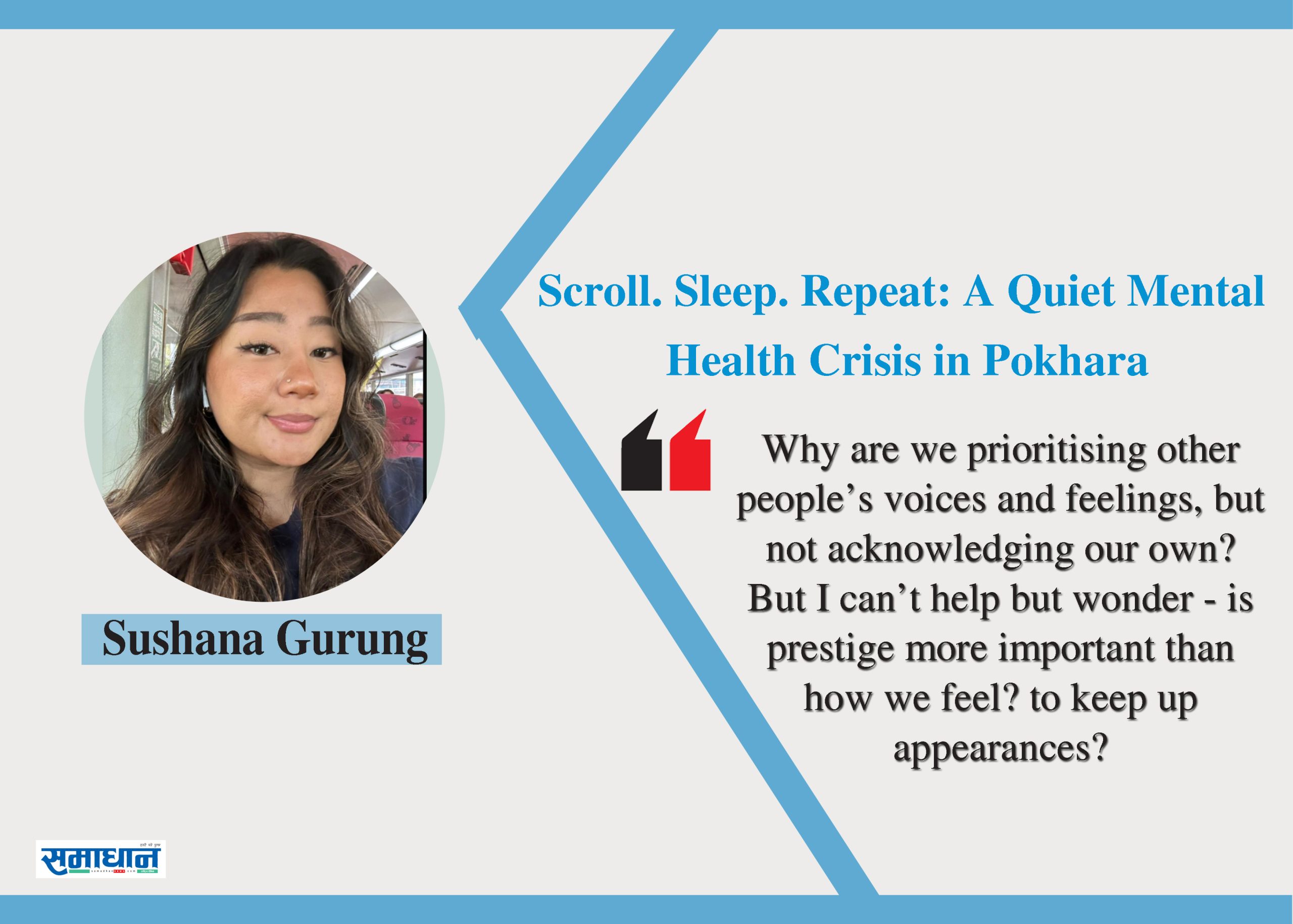
Sushana Gurung.

“I wish society understood that young people’s emotional struggles are real and valid, not just ‘phases.’ They need empathy, support, and safe spaces — not judgment or pressure to toughen up.” said Tenzin . Pokhara may be famous for its tranquil lakes and breathtaking mountains, but beneath its postcard-perfect image, many of its youth are silently struggling with something deeper — emotional exhaustion.
A recent survey of 36 individuals aged 12 to 29 revealed that 57% do not feel comfortable talking about their mental health with friends or family — citing judgment, fear, and lack of emotional support as major barriers. “There’s no space to feel. Just school, stress, and silence,” said Magar (18). Behind exam scores, curated selfies, and silent homes, young people are battling stress, shame, and digital overload. And they’re doing it alone.

As academic pressure and digital dependency rise, mental health remains a topic felt deeply, yet rarely addressed in Pokhara’s homes, classrooms, or public forums. Many young people report turning to doom scrolling, isolation, and even substance use as coping mechanisms — pointing to a growing culture of emotional numbness rather than healing. Magar told me, “It’s always: study, assignments, don’t be lazy. No one asks how we’re actually doing.”And they’re not wrong as 75% said money and identity issues cause them stress, nearly 70% said career pressure weighs on them and over a third struggle with family stress.
“Phone Use Emerges as Coping Tool for Mental Health Struggles” Most young people aren’t turning to others for support. Instead, they turn to their phones. Doom Scrolling — the act of endlessly scrolling through content — came up again and again. Some used it to distract. Some used it to avoid crying. “I doom scroll for hours. By the end, I just feel worse,” Magar (18) said. Others mentioned sleeping too much, crying alone, or even using alcohol.

“Scrolling just to silence the noise in my head. But we end up chasing quick dopamine hits like reels or memes, but nothing really satisfies us anymore. We no longer escape into things that make us feel good organically, phone addiction is just as bad as other addictions as they suck out the joy in life and can make us depressed too. Everywhere I go, everyone is on their phones. Something that used to be a medium to communicate and aid us has instead become a crutch. “
mentioned by Gurung (25) I’ve interviewed other Pokharelis who have told me that they tend to keep to themselves as everyone is judgemental. How terrible societal judgement must be if it has led to people hiding behind screens and to completely steer clear of socialising. As safe and comforting it must be to hide behind screens, these aren’t solutions. They’re survival tactics. And they reflect something bigger: emotional exhaustion. Family Support Often Lacking, Say Youth” “I strongly believe that Mental health support starts from home.
Why are we prioritising other people’s voices and feelings, but not acknowledging our own? But I can’t help but wonder – is prestige more important than how we feel?
If students have a tough time at school, they need to be able to come home to a stable house with parents to put real attention into communicating and they give their children total freedom of speech so they’re encouraged to tell the whole truth about their day. But if a students gets a tough time at school and his house too he’s sure to have terrible anxiety and that can lead to various physiological and behavioral issues at the very least making him a difficult person” said by Anjil (22) A lot of young people mentioned they love their families — but they just can’t talk to them and fear they’ll never understand.
Magar said, “If I told my parents I was depressed, they’d laugh or think I’m weak.” Anjil mentioned that even when people are drowning, older generations would rather label them an “alcoholic” than ask what’s wrong. There’s still so much stigma around emotions. Around crying. Around needing help. Young people do understand, many of our parents weren’t raised to talk about feelings. But we can’t keep pretending everything’s okay just because we’re scared of seeming “soft.”
To be human is to truly exist, feel and love. Our ancestors and elders, our own parents, were taught to just survive and to achieve success. From what I’ve seen from our social norm, there’s so much emphasis on how it looks but not on how it feels. But times are different now. Why are we prioritising other people’s voices and feelings, but not acknowledging our own? But I can’t help but wonder – is prestige more important than how we feel? Are we really okay with killing ourselves slowly just to keep up appearances?
The System Isn’t Built For Healing Let’s be honest. School doesn’t give us space to breathe. Magar told me, “We need centers that offer free classes or activities. Things that help us figure out who we are. Not just more schoolwork.” I wish we had time to process emotions, explore different careers, or even try a side hustle.“ And I agree. School in Nepal often focuses only on marks, not mental health. But in places like Canada or the Netherlands, students have counseling support in schools. They get time to explore themselves.
They’re taught that emotions are part of learning, not a distraction from it. We deserve that too. I firmly believe by teaching our youth that emotions and finding ourselves aren’t a priority, we as a nation will just be forever lost because we’re teaching our future generations to be robots, to do as they’re told and to follow rules but never to think outside the box. If one doesn’t love oneself, how can they love others? Hidden Identities, Silent Pain One moment that hit me hard came from a story shared by Magar, 18.
During a barista course, someone from a lower caste used a fake name — just to avoid being treated differently. “I can’t imagine the stress of hiding who you are just to be treated equally,” she said. That’s not just emotional. That’s trauma. And it’s happening silently around us. In order to thrive and go forward as a society, we need to uplift and understand each other instead of judging others.
The old mentality, societal and cultural norms we so desperately try to please will just keep our country in a cycle that simultaneously goes backwards. So What Do We Do? We don’t need to fix everything overnight. But we can start. As a young person, here’s what I believe could help , normalizing conversations about mental health in school, at home, in friend groups. Why does it feel like talking about our feelings is so taboo? It should be a part of daily life,rather than talking about superficial things and trends that don’t matter.
From my interactions and surveys with youth in Nepal, I realised that Pokharelis hesitate to share or open up, are soft-spoken, introverted and shy away from conversations that go past the surface. But who could blame them? They say you can only meet people as deeply as they’ve met themselves. We should also create local spaces where youth can connect, learn, and heal. Train teachers and parents to recognize when someone is struggling, as youth spend most of their time in school for the first quarter of their lives. Parents don’t get to see first hand what their kids deal with, but teachers do.
I believe being a teacher doesn’t just mean teaching academically but also teaching whole person development. Holding talks to educate students in areas of not just mental health, but also substance abuse, life lessons such as morals and values. Learning about life is just as important as passing exams. Bring in trained counselors to schools and colleges — even one makes a difference. add activities that help youth explore who they are, not just test them on what they memorize. But most of all, we need to listen. The 5 Cs of Mental health are connection,coping,calmness,care and compassion We’re Not Weak.
We’re Worn Out. I think the youth in Pokhara are strong — not because they never struggle, but because they keep going even when no one sees or understands how hard it is. They’re not asking to be fixed. They’re asking to be understood. I believe a person truly flourishes when they are seen,heard,understood and nurtured well by their environment. “Our struggles are real. We need empathy, not judgment,” one girl told me. And she’s right. Because at the end of the day, we’re all just trying to feel a little less alone.



 ‘नेतृत्व परिवर्तन १५औं महाधिवेशनबाट गरौं, अहिले चुनावमा जुटौं’ : कार्यवाहक सभापति खड्का
 म्याग्दीमा जबरजस्ती करणी अभियोगमा एक जना पक्राउ
 सन् २०२५ मा प्रेस स्वतन्त्रता हननका १२१ घटना, बागमती प्रदेश सबैभन्दा असुरक्षित
 चन्दा र श्रमदानबाट घार देउरालीमा दृष्यावलोकन केन्द्र निर्माण
 यात्रुसँग अभद्र व्यवहार गर्ने ५ ट्याक्सी चालकलाई पोखरा विमानस्थलमा १ महिना प्रतिबन्ध
 कास्की कांग्रेसका नेता विमल बसेलले त्यागे पार्टी
 पोखरा २६ को स्कुलको जग्गा व्यक्तिको बनाउने पोखरेलसहित ६ जनाविरुद्ध भ्रष्टाचार मुद्दा
 गण्डकी सांसद भोजराज अर्याललाई पुत्रशोक
तपाईको प्रतिक्रिया